
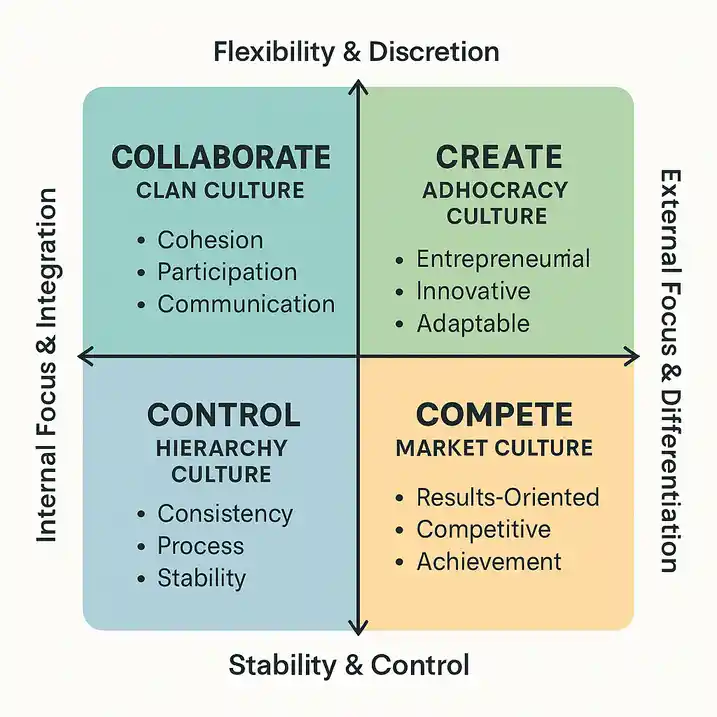
For me, a gap between current and preferred culture starts a conversation. It suggests people want to experience something differently. It does not automatically explain what should change, why it matters or which action will work.
Current and preferred answer different questions
Current culture describes how work usually happens today. Preferred culture explores the way of working your team needs. That preference should make sense for the tasks, safety requirements, customers and goals involved.
Ask what you need to preserve as well as what you want more of. Greater flexibility may help while clear agreements remain necessary.
An example of a culture gap
Suppose collaboration moves from 30 to 40 in an illustrative profile. That is a difference of 10 percentage points, not proof that collaboration becomes 10 percent better. These numbers are a calculation example, not a company result.
In profiles that total 100, the distribution changes: putting more weight on one dimension means less elsewhere. Read the whole profile and ask which situations explain the preference.
Compare people and teams carefully
An average can hide differences. Ask whether leaders experience the same freedom to take initiative as team members. Check who participated, which roles are missing and whether groups are large enough to discuss responsibly.
Differences between departments are not automatically problems. A safety-critical process and an experimental project may need different arrangements. I would ask whether the current way of working helps each team do its job well.
Turn insight into one action
- Choose a difference the team recognizes.
- Ask for a recent situation where it appeared.
- Agree on a specific behavior, such as who reviews suggestions and within what time.
- Assign an owner and a review date.
- Repeat the assessment with a comparable approach and discuss what changed in everyday work too.
The culture change guide helps with follow-through. For recurring assessments and team comparisons, Culture Suite is a standalone product with a clear pricing calculator.
To first understand your own workplace experience, start the free personal culture test. Your perspective is a useful beginning; a team picture needs several voices.
Culture Suite
Assess culture with your team
Compare several perspectives and follow culture over time with Culture Suite. A standalone product, with no vacancy required.